Protecting Your Investment: The Ultimate Guide to Packing Furniture for a Long-Distance Move
 Phaelariax Vylorn
Moving across the country is not merely a transfer of belongings; it is a complex logistical expedition. While local moves often involve short durations and familiar environments, long-distance relocations expose your furniture to an entirely different set of environmental and physical stresses. When your valuables spend days or even weeks in the back of a truck, they are subjected to thousands of miles of vibration, shifting humidity, and mechanical friction. Protecting your investment requires moving beyond basic household supplies and adopting the mindset of a logistics professional. By implementing a rigorous system of planning, disassembly, and expert-grade packing, you can ensure your furniture arrives in the same condition it left. This guide explores the engineering behind safe furniture transit and provides the actionable, expert-level strategies needed for a successful long-distance move.
Why Long-Distance Moving Requires a Higher Standard of Care
The Physics of the Long Haul: Transit Vibration and Friction
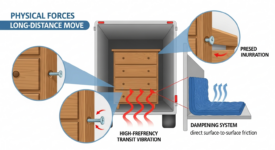
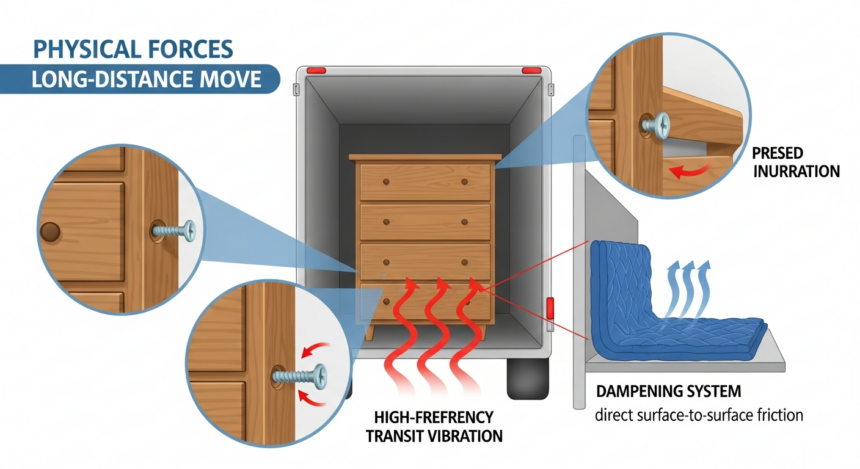
The physics of transit: How constant road vibration causes structural loosening and surface friction, and how proper padding acts as an essential dampening system.
During a multi-day journey, a trailer experiences constant vibration. Over hundreds of miles, this subtle, high-frequency energy acts like a sander against furniture surfaces. When two pieces of furniture—or a piece of furniture and a wall—rub together even slightly, the friction wears away finishes and causes structural loosening. Furthermore, road-induced bouncing can cause screws to back out of wood, compromising the integrity of frames. Understanding these physics highlights why padding is not optional; it acts as a dampening system that absorbs vibration and prevents direct surface-to-surface contact.
Climate and Humidity: How Environmental Changes Affect Wood and Leather
Long-distance transit often takes you through varying climate zones. A piece of fine wood furniture moving from a humid coastal region to a dry mountain environment undergoes rapid moisture loss, which can cause wood to shrink, crack, or warp. Leather is similarly sensitive and can become brittle when exposed to prolonged temperature swings in a non-climate-controlled trailer. Preventing damage requires creating a stable micro-climate for your items through proper wrapping techniques that avoid sealing in damaging moisture.
Shifting Loads: Why Local Moving Techniques Fail on the Interstate
Local moving often ignores the “Load Factor,” but on the interstate, weight distribution is paramount. A truck that is not tightly packed will experience “load shift” during turns and braking. If items are not braced against each other or strapped securely, they become projectiles. Unlike local moves where you might “cushion” items with pillows, long-distance moves require rigid, structural support to keep the center of mass low and stable.
Phase 1: The Strategic Pre-Move Audit
Creating a Digital Inventory and Photo Documentation
Before you lift a single box, document your furniture. Create a digital inventory accompanied by high-resolution photos of every angle, specifically capturing pre-existing scratches or structural flaws. This documentation is your primary tool for insurance claims and also serves as a guide for reassembly. Knowing exactly where every screw and bolt originated prevents the “mystery part” scenario during the move-in process.
Measuring Twice: Navigating Doorways, Hallways, and Narrow Alleys
Measure your furniture’s dimensions alongside your new home’s entry points. A piece that fits in your current living room might not pass through a narrow hallway or low-clearance doorway at your destination. Identifying these bottlenecks during the planning phase allows you to decide whether to leave the item behind or devise a complex maneuvering plan.
The “Keep or Toss” Decision: Assessing Replacement Cost vs. Shipping Weight
Long-distance moving costs are largely driven by weight and volume. If an item is low-value and heavy, it may actually cost more to ship than to replace. Evaluate your furniture critically. If the transit cost represents a significant percentage of the item’s resale value, it is often more logical to sell the piece and allocate that budget toward professional movers for your high-value heirlooms.
The Disassembly Masterclass: Reducing Risk and Volume
Essential Tools for Damage-Free Disassembly
A well-stocked toolkit is mandatory. You will need a cordless impact driver with adjustable torque settings, a set of high-quality screwdrivers, Allen keys, and a rubber mallet for gently tapping stubborn joints. Always use the lowest torque setting to avoid stripping screws or cracking wood veneer.
The Hardware Management System: Labels, Sealable Plastic Bags, and Tape
The most common cause of reassembly failure is lost hardware. Use the “Attached Hardware” method: place all screws, bolts, and brackets into a heavy-duty, sealable plastic bag. Tape this bag directly to the primary piece of furniture. Do not collect parts from different pieces in a central “parts box,” as this creates a massive sorting headache upon arrival.
Handling Complex Items: Come Apart Sofas, Sectionals, and Bed Frames
For complex upholstery, remove the legs first. If a sofa cannot fit through a standard doorway, consult the manufacturer for instructions on removing the back or arms. Bed frames must be completely dismantled; never attempt to move a bed frame with the side rails attached, as the lateral pressure during a turn can snap the headboard bolts.
Removable Components: Shelves, Knobs, and Glass Insets
Remove all shelves from bookcases and dressers. Tape the shelf pins inside the cabinet with masking tape to prevent loss. Remove glass insets, knobs, and hardware, wrapping them individually in bubble wrap. Leaving these attached creates protruding failure points that are highly susceptible to damage during loading.
The Professional Material Suite: Beyond Basic Cardboard
Professional-Grade Moving Blankets vs. Standard Furniture Pads
Standard consumer-grade blankets are too thin to provide adequate vibration damping. Invest in professional-grade furniture pads—heavy-duty, quilted blankets that provide significant loft. These should be your primary defense against transit friction.
The Correct Use of Plastic Stretch Wrap (and When It Causes Damage)
Stretch wrap is excellent for keeping drawers closed and blankets in place, but never apply it directly to wood or leather. Plastic creates a seal that traps humidity, which can lead to “clouding” or mold growth in the finish. Always wrap your furniture in a breathable layer (like paper or moving blankets) before applying the outer layer of stretch wrap.
Specialized Protection: Corner Guards, Edge Protectors, and Mirror Boxes
Corners are the most vulnerable points on any piece of furniture. Use plastic or cardboard edge protectors to distribute pressure. For glass mirrors or marble tops, custom-built mirror boxes are the gold standard, providing a rigid shell that prevents cracking.
Using Bubble Wrap and Packing Paper for Fragile Surfaces
Use packing paper as the base layer for all wood surfaces, as it is breathable and non-abrasive. Bubble wrap should be reserved for glass, metal, or plastic components. Never use bubble wrap against finished wood, as the plastic texture can leave permanent impressions over thousands of miles.
Surface-Specific Wrapping Techniques
Protecting Wood Surfaces: Breathable Layers and Avoiding Tape Residue
Avoid using adhesive tapes on finished wood. If you must secure paper, tape the paper to itself, not the furniture. This prevents the chemical damage that often occurs when tape adhesive interacts with wood stains or lacquer over long periods in a warm, unventilated truck.
Glass and Fragile Surfaces: The “X” Method and Double-Boxing
For large mirrors or glass tabletops, apply masking tape in an “X” pattern across the surface. This prevents the glass from shattering into fine pieces should an impact occur. Always double-box glass; place the wrapped piece inside a smaller box, then place that box inside a larger one with two inches of packing peanuts between them.
Upholstery and Leather: Preventing Tears, Dust, and Pressure Marks
Use furniture-grade plastic covers specifically designed for sofas and chairs. These protect against dust and stains during the move but are breathable enough to prevent the trapped-moisture issues associated with standard stretch wrap.
High-Value Antiques: Why Some Items Require Custom Crating
If you own irreplaceable antiques, do not rely on standard wrapping. Custom wood crating provides a rigid structure that eliminates pressure points. The investment in crating is a small insurance premium compared to the cost of restoring a damaged historical piece.
Safe Maneuvering: Protecting Your Home’s Infrastructure
Floor Protection: Using Furniture Sliders and Masonite
Protecting your home is as important as protecting the furniture. Use felt sliders for hardwood floors and sheets of Masonite to create a “roadway” for heavy items across carpeted areas. This prevents gouges and crushed pile.
Defensive Architecture: Door Frame Guards and Corner Protectors
Use foam padding or cardboard to wrap door frames and corner guards in narrow hallways. This prevents cosmetic damage if a heavy furniture item brushes against the infrastructure during transit.
Body Mechanics: Lifting Straps, the High-Low Technique, and Center of Mass
If you own irreplaceable antiques, do not rely on standard wrapping. Custom wood crating provides a rigid structure that eliminates pressure points. The investment in crating is a small insurance premium compared to the cost of restoring a damaged historical piece. For these irreplaceable assets, it is highly recommended to collaborate with specialized antique movers who possess the technical expertise, custom materials, and climate-controlled transport options necessary to preserve your collection’s structural and aesthetic integrity over long distances.
Mechanical Aids: Using Dollies, Hand Trucks, and Stair-Climbers
Invest in a high-quality four-wheel furniture dolly with rubber wheels. Rubber wheels protect flooring better than hard plastic alternatives. For stairs, utilize a professional-grade stair-climber hand truck, which distributes weight across multiple steps.
Loading for Stability: The Logistics of a Secure Truck
The most effective way to load a truck is the “Wall Method.” Build tight, floor-to-ceiling walls of furniture, starting at the front of the truck and working toward the rear. Interlock the items like bricks to eliminate gaps. Every item should be strapped to the truck’s E-track system to prevent forward or backward movement. By distributing weight evenly across the axle, you ensure the truck is stable on the road, which is the final, vital step in protecting your investment.
Conclusion
Protecting your furniture for a long-distance move is an exercise in risk mitigation. By prioritizing the physics of transit, performing a strategic pre-move audit, and utilizing professional-grade materials, you move from a reactive stance to an expert-driven strategy. Remember: the goal is to create a secure, stable, and breathable environment for your belongings throughout their journey. Whether you choose to hire professional movers or manage the logistics yourself, the principles of hardware management, surface protection, and load stability remain the cornerstones of success. Document your inventory, handle your hardware with care, and never compromise on padding quality. With these steps completed, you can move forward with confidence, knowing your investment is prepared for the road ahead.